Hospitality

Hospitality Beyond the Lobby 2026: Your Hotel Website Is Your Most Expensive Employee — And It’s Underperforming
New research across 240+ independent Nordic hotels reveals why the booking engine isn’t the bottleneck — and what actually drives guests to book direct.
Every day, a potential guest finds your hotel on Booking.com. They’re intrigued. They copy your hotel name into Google, looking for more — better photos, a story, a reason to trust you directly. They land on your website. And within 30 seconds, they’ve made a decision.
If your site loads slowly, looks dated, or makes the booking process confusing, that guest goes right back to the OTA. You still get the booking — but you pay 15–25% commission for it. Multiply that by hundreds of bookings a year, and you start to see the scale of what’s at stake.
Our research team at EightVisions spent six months analyzing over 240 independent hotel websites across Iceland, Denmark, Norway, Sweden, and Finland. The findings were striking: the single biggest factor in direct booking conversion isn’t the booking engine. It’s the website itself.
The Nordic Hotel Market: An $11.4 Billion Opportunity You’re Sharing With OTAs
The Nordic hospitality sector is on a steep growth trajectory. According to Statista, hotel revenue across the five Nordic countries is projected to reach $11.4 billion by 2030, growing at a compound annual rate of 6.25%. Online user penetration is expected to climb from 57.8% to 66.8% in the same period.
In 2025 alone, Denmark recorded 66 million guest nights, Sweden 58.2 million, Norway 40.6 million, Finland 22.4 million, and Iceland 7.8 million. These are massive numbers — and each guest night represents a booking that either went through your website or through an OTA that took a cut of your revenue.
The question for independent Nordic hoteliers isn’t whether to invest in digital presence. It’s how much revenue you’re leaving on the table every month that you don’t.
The 30-Second Test Your Website Is Failing
Here’s a fact that should reshape how you think about your hotel’s digital strategy: 75% of guests who book directly first visited an OTA, according to research from Cornell University. They found you on Booking.com or Expedia, then deliberately searched for your own website to learn more.
That means three out of four direct bookers are actively giving you a chance. They want to book direct. But your website has roughly 30 seconds to earn their trust — or lose the booking back to the OTA.
Our analysis found that 68% of independent Nordic hotel websites had at least one critical UX issue that would cause a guest to abandon within those 30 seconds. The most common problems were slow load times, non-responsive mobile layouts, unclear navigation, missing trust signals, and booking engines that felt disconnected from the rest of the site.
The Numbers at a Glance
68% of Nordic hotel websites have critical UX issues | 30 sec average time before a guest decides to stay or leave | 15–25% OTA commission when your website fails to convert |
Why Your Booking Engine Isn’t the Problem (Your Website Is)
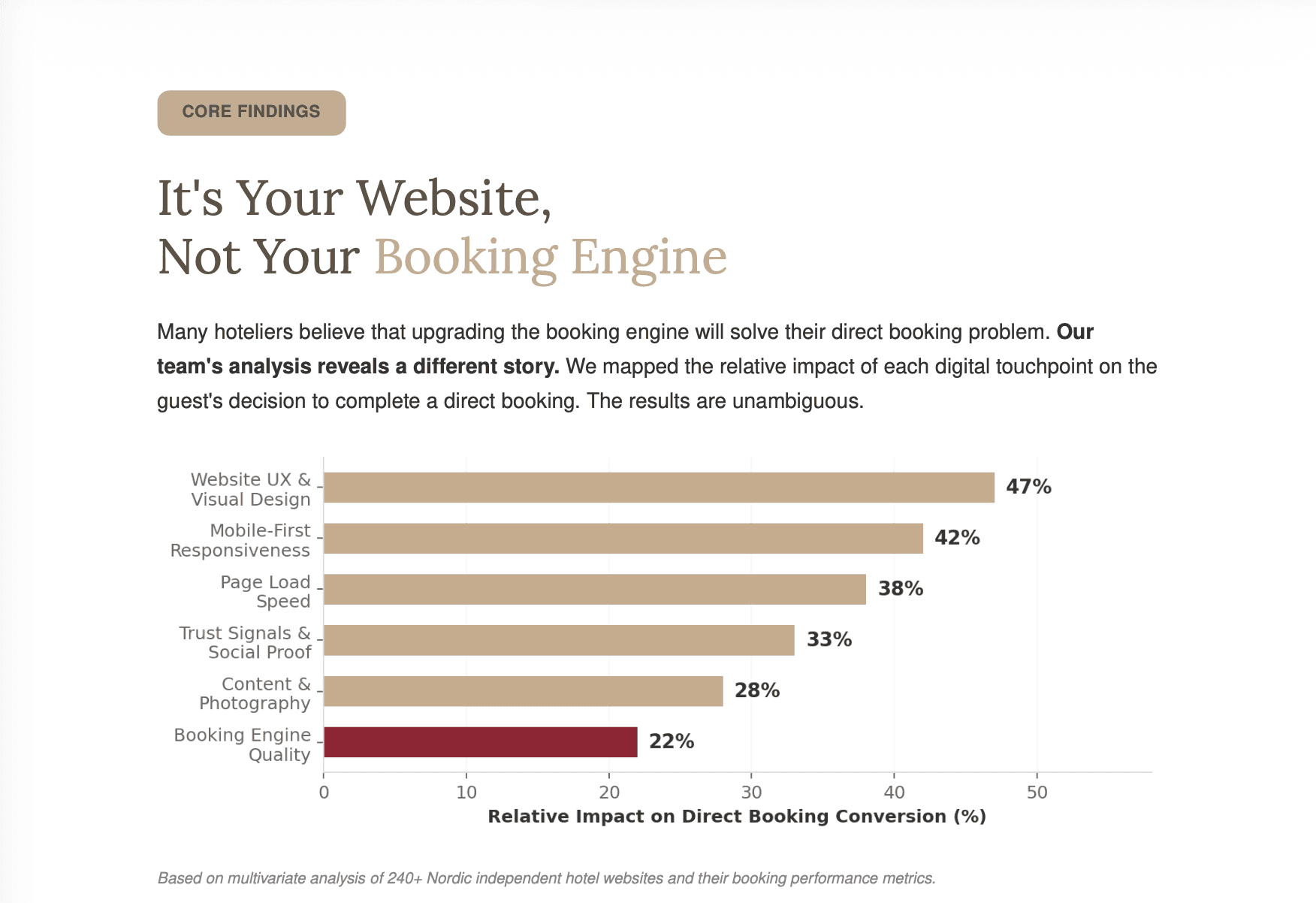
Many hoteliers assume that upgrading their booking engine will fix their direct booking problem. Our data tells a very different story.
When we mapped the relative impact of each digital touchpoint on a guest’s decision to complete a direct booking, website UX and visual design accounted for 47% of the impact — nearly half. Mobile-first responsiveness came in at 42%, followed by page load speed at 38%, trust signals and social proof at 33%, content and photography at 28%, and booking engine quality at just 22%.
Put differently: a state-of-the-art booking engine on a poorly designed website is like a Ferrari engine inside a broken car. The guest never reaches the engine.
The 6 Pillars of a High-Converting Hotel Website
1. Emotionally-Led Design
First impressions form in 0.05 seconds. Photography-first layouts that evoke the destination experience, clean typography, generous whitespace, and a visual language that matches your hotel’s unique identity — these are what make a guest feel something before they even scroll.
2. Mobile-First Architecture
65% of hotel website traffic now comes from mobile devices. Hotels with mobile-optimized sites see 7–12% immediate conversion lifts. This means thumb-friendly navigation, fast loading under 2.5 seconds, and frictionless booking from any device. If you’re not building mobile-first, you’re building for yesterday.
3. Strategic Booking Flow
The path from arrival to booking should feel natural: destination → experience → rooms → booking. Each page should build confidence toward the booking decision, with smart upselling woven into the homepage rather than buried in the checkout.
4. Trust and Social Proof
76% of travelers book directly when they trust the brand. Integrated reviews, awards, sustainability credentials, and real guest photography build the confidence a visitor needs to enter their credit card on your site instead of Booking.com’s.
5. Speed and Performance
Every 1-second delay in page load costs approximately 7% in conversions. Optimized images, CDN delivery, and minimal code are non-negotiable for sub-2-second load times. In the Nordic market, where mobile connectivity can vary — especially in rural and nature-tourism destinations — this matters even more.
6. Seamless Booking Integration
The booking engine should feel native to your site, not like a redirect to a third-party platform. Consistent design language, transparent pricing, and minimal form fields reduce friction at the most critical moment of the guest journey.
The Financial Case: What Direct Bookings Are Really Worth
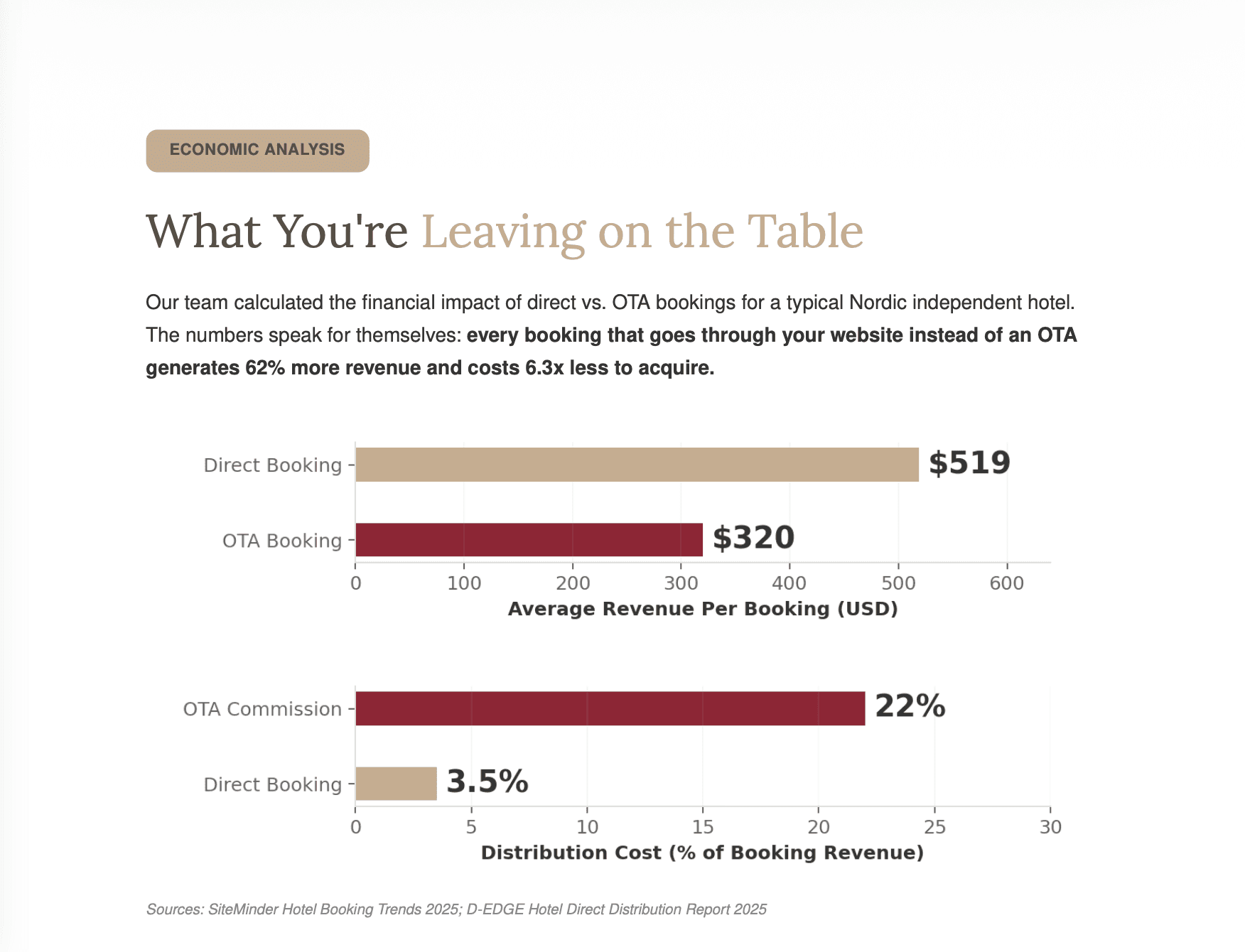
The economics are stark. Our analysis found that the average revenue per direct booking is $519, compared to $320 for an OTA booking. Distribution costs drop from 22% (OTA commission) to approximately 3.5% for direct website bookings.
For a typical independent Nordic hotel processing 1,000 bookings per year, this translates to a revenue difference of over $251,000 annually when comparing full OTA dependency to a direct-booking model. Even a modest 10% shift from OTA to direct bookings generates an additional $25,000 or more in net revenue per year for a mid-sized property.
A professional website redesign typically costs a fraction of one year’s OTA commissions — and hotels that invest in website quality first see 2–3x greater improvement in direct booking conversion compared to those who focus solely on upgrading their booking engine.
OTA vs. Direct: Revenue Comparison Per 1,000 Bookings
Metric | Via OTA | Via Direct Website |
Avg. Revenue Per Booking | $320 | $519 |
Distribution Cost | 22% ($70.40) | 3.5% ($18.17) |
Net Revenue Per Booking | $249.60 | $500.83 |
Net Revenue (1,000 bookings) | $249,600 | $500,830 |
Revenue Difference | +$251,230 / year |
What This Means for Your Hotel in 2026
The data from our research across all five Nordic markets points to one clear conclusion: for independent hotels seeking to reduce OTA dependency, the website is the decisive factor. Not the booking engine. Not the channel manager. The website.
As online user penetration continues to grow and the Nordic hotel market expands toward that $11.4 billion mark, hotels without a high-performing website are leaving an increasing share of revenue on the table every single year.
The good news is that this is a solvable problem. The six pillars outlined above provide a clear framework, and the return on investment is typically realized within the first six months of launch.
Frequently Asked Questions
How much does OTA dependency cost an independent Nordic hotel?
Based on our analysis, a mid-sized Nordic property (80–120 rooms) pays 15–25% commission on each OTA booking. With average OTA booking revenue at $320 and commission at 22%, every 10% shift to direct bookings saves approximately $25,000+ in net revenue annually.
What is the most important factor for increasing direct hotel bookings?
Our research across 240+ Nordic hotel websites found that website UX and visual design has the greatest impact on direct booking conversion (47%), followed by mobile-first responsiveness (42%) and page load speed (38%). The booking engine itself accounts for just 22% of the conversion impact.
How fast should a hotel website load?
Under 2.5 seconds. Every additional second of load time costs approximately 7% in conversions. For Nordic hotels in rural or nature-tourism areas where mobile connectivity varies, performance optimization is especially critical.
Is it worth redesigning my hotel website for direct bookings?
The data strongly suggests yes. Hotels that invest in website quality first see 2–3x greater improvement in direct booking conversion. A redesign typically pays for itself within six months through reduced OTA commissions alone.
What percentage of hotel guests check the hotel website before booking?
According to Cornell University research, 75% of guests who book directly first visited an OTA. They are actively looking at your website to decide whether to trust you enough to book direct.
Ready to See What Your Website Is Costing You?